How Google's AI Decides Which Dental Practice to Recommend
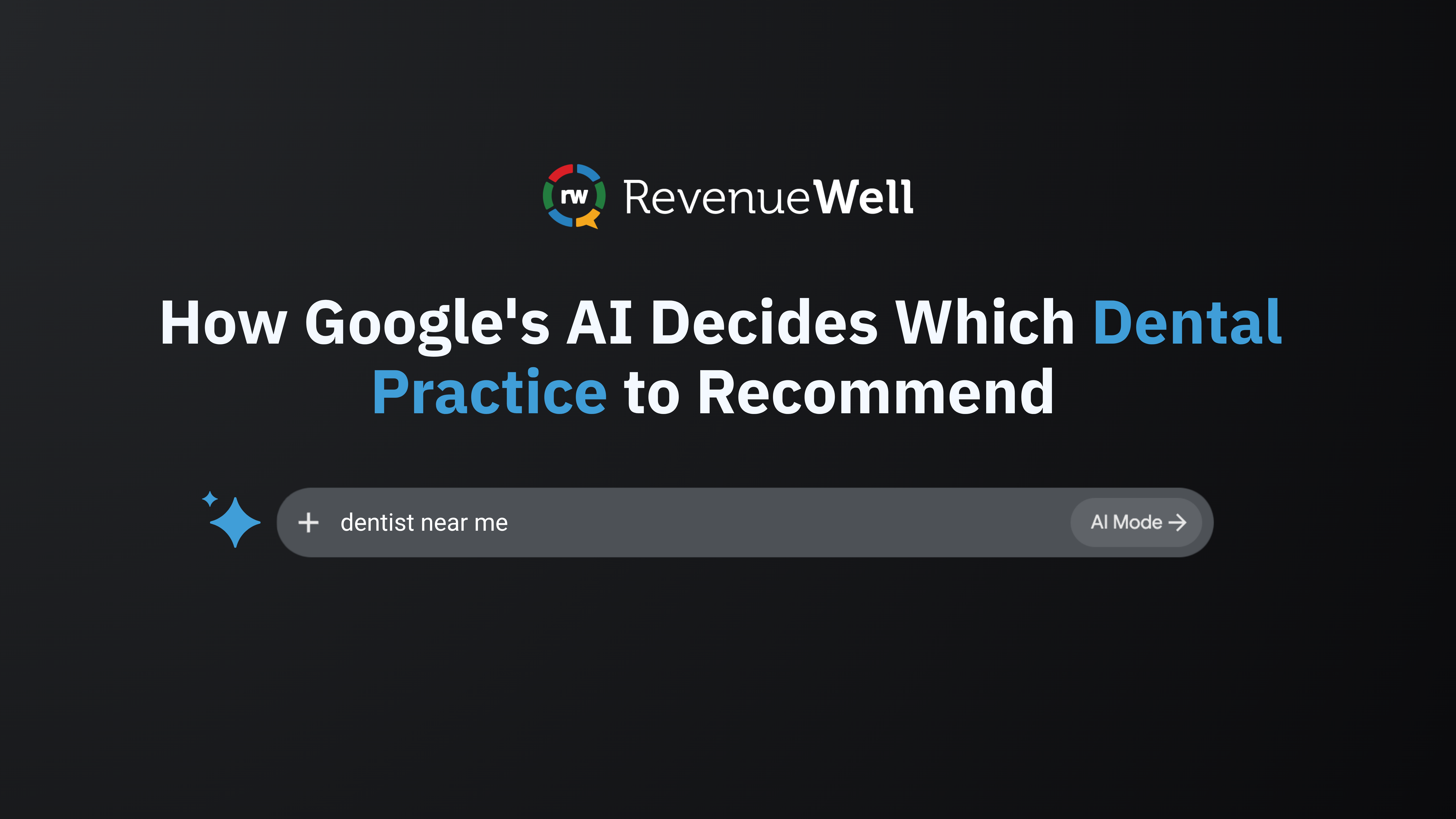
There's a quiet competition happening right now in every local market across the country — and most dental practices don't even know they're in it.
When a patient types a question into Google — about a toothache, the cost of a procedure, what to expect from treatment, or simply which practice to trust — something new is happening at the top of the results page. Google now generates an AI-powered summary that answers the patient's question directly, before they ever scroll to a website, a review, or a Map Pack listing. It's choosing which practices to name, cite, and describe as trustworthy — and it's doing it before a single click happens.
The practices being named are getting significantly more patient inquiries. The ones being left out are losing that first moment of consideration entirely.
Here's what you actually need to understand about how Google's AI makes that decision.
Google's AI Is Not Random — It's Reading Signals
Google's AI Overviews don't pull recommendations out of thin air. The AI is trained to surface the most trustworthy, relevant, and locally authoritative answers to a patient's question — and it pulls from a specific set of signals to figure out which practices qualify.
This is where it gets important: Google's AI doesn't just read your website. It synthesizes signals from multiple sources — your website content, your Google Business Profile, your review profile, third-party directories, the technical side of your website, and engagement data from real patients interacting with your listing.
The practices that show up in AI recommendations tend to have one thing in common: they look trustworthy and active across all of those sources simultaneously. Not just on one or two.
The Four Layers Google's AI Is Evaluating
1. Topical Authority — Does Your Website Actually Answer What Patients Are Asking?
Google's AI evaluates whether your content addresses the full arc of patient questions — not just whether you list a service.
For any procedure a patient is considering — whether that's Invisalign, implants, whitening, or a simple cleaning — they arrive at Google with questions about cost, candidacy, timeline, and what to expect day-to-day. A practice whose website genuinely addresses those questions signals to Google's AI that it's a trustworthy source worth recommending. A practice with a page that simply names the service does not.
That depth needs to exist across every service you offer. The gap between a page that names a service and one that genuinely addresses it is exactly what Google's AI is measuring — and most dental websites fall firmly on the wrong side of that gap without ever realizing it.
2. Local Relevance — Are You a Real Part of This Community?
Google's AI distinguishes between a practice that happens to be located somewhere and one that is genuinely embedded in that community. The difference matters more than most practice owners realize.
A practice that looks locally rooted — through its content, its online activity, and the way real patients describe it — earns more relevance in AI recommendations than one that looks interchangeable with any practice in any city. Generic digital presences get generic results.
The challenge is that local relevance isn't a single thing you fix once. It's a signal Google reads continuously — and it compounds over time in both directions.
3. Trustworthiness — What Does Your Engagement Pattern Look Like?
Here's the part most practices miss entirely. Google's AI doesn't just evaluate what your listing says — it evaluates how real patients behave when they encounter it.
Engagement patterns across your listing and website tell Google's AI something no amount of optimization can fake: whether actual patients find you credible enough to act on. Practices with strong engagement signals are essentially being vouched for by their own patient base — and Google treats that as the most reliable signal of all.
The catch is that engagement isn't something you can switch on. It's the byproduct of everything else working together — and it's the hardest signal to manufacture and the easiest to lose.
4. Technical Foundation — Can Google Actually Read What You've Built?
Content depth and local relevance only matter if Google's AI can properly interpret your website in the first place. This is the layer most practice owners never think about — and it quietly undermines everything else.
A technically sound website loads quickly, is structured in a way Google can crawl without friction and uses schema markup to label what each piece of content actually is — your practice name, your services, your location, your providers. Schema is the website equivalent to clear signage: it tells Google's AI exactly what it's looking at, rather than making it guess. In a controlled experiment, the only page to appear in a Google AI Overview was the one with well-implemented schema — the pages with poor or no schema didn't appear at all.
Google has been consistent with this: the technical best practices that support strong search rankings apply equally to AI visibility. A practice can produce excellent content and still be invisible if the foundation underneath it is broken.
The Compounding Effect — and Why Timing Matters
Google's AI recommendations aren't static. The AI continuously updates which practices it cites — and those shifts compound quickly in both directions.
A practice building strong signals now starts appearing in more AI answers. More AI appearances drive more patient inquiries. More inquiries generate more engagement signals. The cycle builds on itself — and it builds fast.
The reverse is equally true. A practice whose signals are stagnant sends Google's AI a quiet message every month that passes: another practice nearby is more active, more trusted, more worth recommending.
Without someone actively managing those signals, most practices drift in the wrong direction without realizing it — until it shows up in their schedule.
In most local markets, the window to move first is still open. But it narrows every month.
What This Means for Your Practice
Google's AI doesn't reward effort — it rewards evidence. The practices appearing in AI recommendations have built something Google can consistently point to as credible: content with real depth, a digital presence that's coherent across every platform a patient might encounter, and engagement signals that reflect genuine patient trust.
For most practice owners, sustaining that kind of presence competes directly with something more important: running the practice itself. Patient care, staff, scheduling, operations — there's no shortage of things demanding attention before digital signals make the list.
That kind of presence doesn't happen by accident, and it doesn't stay strong without sustained attention. In a market where most practices are still running on outdated foundations, the ones investing in getting this right now are the ones that will be entrenched in Google's recommendations when their competitors finally notice the gap.
The Question Worth Asking Right Now
Every day, patients in your area are turning to Google with questions — about pain, procedures, costs, what to expect — and Google's AI is answering before they ever click a single result. Some practices are being recommended in those answers. Others aren't showing up at all.
The answer to which side your practice is on lives in your content, your Google Business Profile activity, your review profile, and how patients engage with your listing. Most practice owners don't have a clear picture of where they stand across all of those signals — and that uncertainty is exactly what a competitor nearby may already be taking advantage of.
If you'd like to understand where your practice stands—and uncover the opportunities that could help you attract more new patients—schedule a consultation with RevenueWell's digital marketing team. We'll help you identify the gaps, prioritize the right strategies, and create a plan for improving your online visibility before your competitors get there first